Contractors vs. Manufacturers: Who’s Really Responsible When Insulation Fails?
When insulation fails, it doesn’t usually do so in a vacuum. It fails in the walls of someone’s dream home, or under the roof of a brand-new ag building. It fails behind the drywall, above the steel purlins, and under the radar—until it doesn't. Until there's condensation on the window, a soft spot underfoot, an energy bill that doesn’t make sense, or a customer with questions you’d really rather not answer.
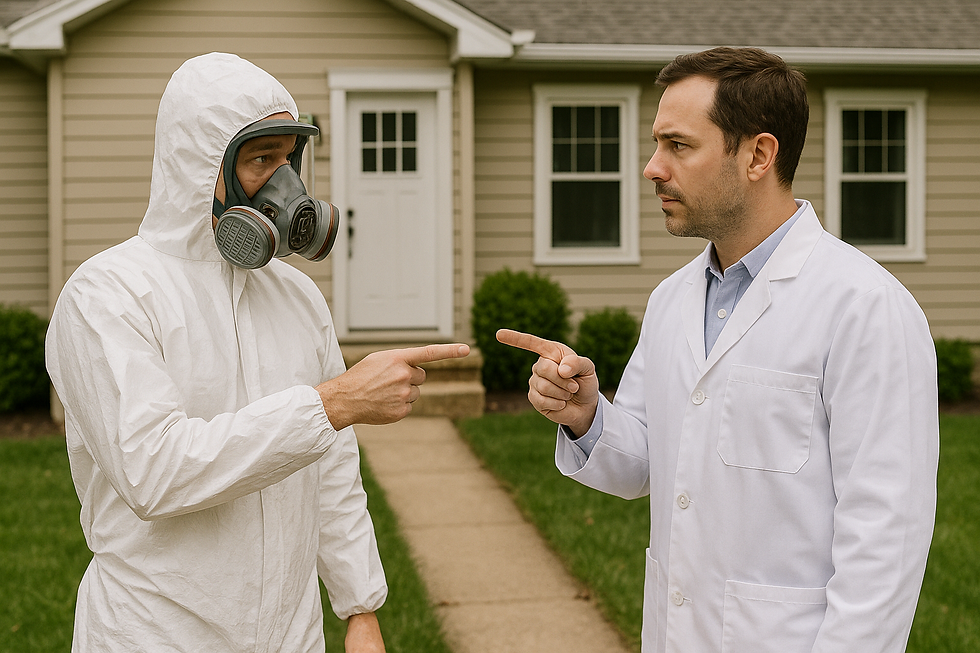
And when that happens—when foam underperforms, delaminates, traps moisture, or flat-out shrinks—somebody’s going to want answers. More often than not, that question gets framed like a courtroom showdown:
Was it the foam? Or the guy who sprayed it?
That binary framing, while tempting, ignores the truth of the matter. Because when insulation fails, what we’re really looking at is a breakdown of the whole system—product, process, environment, and expectations.
So let’s break this all down: what constitutes a “failure,” where contractors and manufacturers fit into the responsibility chain, how common failure modes actually unfold on real jobs, and what to do when it’s your phone that rings.
Failure Isn’t Just Foam Falling Off the Wall
Ask a building scientist what insulation failure means, and they won’t tell you it’s just “peeling off the studs.” That’s the dramatic kind—the one you can post a photo of. But failure often hides. It can be as quiet as a permanent cold spot in the corner of a bedroom. As invisible as slowly rotting wood behind a sealed-up wall. As indirect as an HVAC system working harder than it should.
In spray foam jobs, failure can show up in all sorts of ways:
Foam that never reached its expected R-value.
Adhesion that breaks down because the substrate was damp—or just too smooth.
Off-ratio mix from a dirty drum pump.
Foam that shrinks away from framing because it cured too hot.
Or maybe just lifts that were sprayed too thick on a humid day when nobody was watching the gun temperature.
Some of these failures take months to reveal themselves. Others don’t surface until the building changes hands, or a building inspector cuts into the wall. But one thing’s for sure: when failure does surface, everyone wants to know who’s footing the bill.
The Manufacturer’s Role—and Limits
It’s easy to point fingers at the company that made the foam. After all, they’re the ones who sold the system, printed the specs, and guaranteed the yield. If a 2.0lb closed-cell foam doesn’t hit its advertised R-6.9 per inch, isn’t that on them?
Sometimes it is. If there’s a formulation issue, a bad batch, or a quality control miss at the plant, then yes—the manufacturer may be on the hook. But more often, what the warranty covers is narrow. They guarantee that the chemical blend, when installed per their guidelines, will meet the performance claims. Those guidelines typically include things like:
Substrate temperature.
Ambient humidity.
Lift thickness limits.
Cure times.
Mix ratios.
Proper drum pre-conditioning.
So if any of those variables were off—and they weren’t the ones installing it—you can guess where they’ll steer the blame.
Some manufacturers do offer site-specific technical support or job inspections. Some require installers to go through training or certification before they’ll even honor a warranty. But unless the failure is clearly due to product defect, they’ll often push it back toward the field crew.
That doesn’t make them evil. It just means their risk model assumes the field team knows how to apply the product. And if that assumption fails… well, the foam isn’t the only thing under pressure.
The Distributor: The Middleman With More Power Than You Think
If the manufacturer makes the foam, and the contractor sprays it, then the distributor is the one moving it. On paper, their role seems simple: buy from the manufacturer, deliver to the contractor, and get out of the way. But in practice, distributors shape a surprising number of the conditions that can influence whether a job succeeds—or fails.
Start with storage. Foam chemicals are temperature-sensitive. Isocyanates in particular degrade if stored below freezing or exposed to high humidity. Open-cell and closed-cell kits often need to be conditioned to a specific range (typically 70°F–85°F) before use—not just at the time of spraying, but for days before. If those drums sit in a cold warehouse, or on an unconditioned truck, or get moved on-site without anyone checking their temp, you can kiss proper performance goodbye.
And then there’s substitution. Let’s say you spec’d Carlisle SealTite Pro 2.0, but your distributor’s out of stock and sends NCFI InsulBloc instead. Both are 2.0lb closed-cell foams—but they don’t spray the same, they don’t cure the same, and their yields are different. Some distributors may push these swaps without updating the TDS, or worse, without notifying the installer at all.
That substitution might not be malicious. Sometimes it’s a rushed delivery, an inventory squeeze, or just a rep trying to help you keep a project on schedule. But if that change leads to adhesion issues, shrinkage, or R-value shortfalls? You’re the one holding the bag.
Distributors also tend to act as technical liaisons. They’ll often be the first call a contractor makes when something seems off. But here’s the tricky part: advice given by the distributor isn’t always backed by the manufacturer. If you followed a distributor’s recommendation—say, about reusing leftover foam drums from a previous job—and something fails? Don’t expect the manufacturer to come rushing to your defense.
To be clear, many distributors are invaluable partners. They help contractors get set up. They provide on-site tech support. They run training events. They advocate for better margins. But when it comes to responsibility? Distributors operate in a gray zone. They're often not contractually tied to the end-user in the same way a contractor or manufacturer is. And that makes it very easy for them to step back when something goes wrong.
So what’s the takeaway?
Get your specs in writing. If you spec’d a specific foam, get confirmation of the exact product being shipped. Don’t rely on “equivalent” or “same yield” claims.
Ask about storage and handling. Especially in cold climates or during seasonal transitions. A foam drum frozen in transit isn’t always visible until it’s too late.
Document everything. If your distributor offers guidance or substitution, get it in writing—or at least email. Protect your trail.
Loop the manufacturer in when anything seems off. Don’t rely solely on the distributor’s word if the job’s on the line.
Distributors are part of the ecosystem. But when insulation fails, they’re often the most slippery player in the room. Don’t assume they’ll take responsibility—unless you’ve made it clear from the start where their role begins and ends.
The Contractor’s Cross to Bear
Here’s the hard truth: most insulation failures are installation-related. Not because contractors are careless, but because the jobsite is messy. Substrates vary. Weather changes. GCs rush timelines. Drums sit in the sun. Subfloor moisture isn’t always measured. And sometimes the guy pulling the trigger is running on four hours of sleep and one granola bar.
But the contractor is also the last line of defense. When that spray gun turns on, they are the one who has to know:
Whether the surface is ready.
Whether the chemicals are conditioned.
Whether the crew understands lift timing.
Whether the room’s humidity is under control.
Whether the product being used is actually approved for that roof deck.
That’s a lot to track. And to make matters worse, many contracts don’t spell it out. They say things like “installed per manufacturer spec” or “as designed by the engineer”—without making it clear who’s responsible for verifying conditions on site.
And when it fails? It’s rarely the engineer that gets sued. It’s the guy whose logo is on the invoice.
The Blame Chain: How It Usually Plays Out
When insulation fails, people look for the simplest narrative. Product bad. Installer bad. Building owner unreasonable. But the reality is usually more layered.
Sometimes the product was the wrong choice for the building. That’s on the specifier or architect. Sometimes the product was right, but was installed in the wrong conditions. That’s on the installer. Sometimes the product was substituted last-minute without full approval. That’s on whoever approved the change order. And sometimes the install was perfect, but the structure itself allowed moisture to creep in later—and the foam just hid the damage.
The key to unwinding these scenarios is documentation. If the contractor took photos, logged ambient temps, recorded foam batch numbers, and followed a clear install protocol, they stand a far better chance of defending their work. If they didn’t? It’s going to be their word versus the building owner’s frustration—and that’s rarely a good position to be in.
A Word on Spray Foam’s Unique Risks
Unlike batt insulation or blown-in cellulose, spray foam doesn’t get a second chance. Once it’s on the wall, it’s on the wall. And that’s what makes spray foam so uniquely prone to high-stakes failure.
If you sprayed too thick and the foam overheated, you may not see the charred center until someone cuts it open. If your substrate was cold and wet, you might not see adhesion issues until weeks later. If you ran out of open-cell mid-roof and swapped in closed-cell to finish the job, that could cause condensation and trapped moisture where you least expect it.
Even something as subtle as substrate smoothness matters. Some manufacturers (like Carlisle or NCFI) warn explicitly against applying closed-cell foam to smooth metal or glazed surfaces without mechanical abrasion. Others specify pre-treatment or priming for certain substrates.
And yet in the field? That warning label often gets ignored because someone’s watching the clock. Or the weather. Or the cost per set.
Foam is not forgiving. It’s powerful, effective, and wildly versatile—but only when it’s respected.
What About Insurance? Who’s Covered — and Who’s Not?
Insurance is often the last thing anyone wants to deal with — until something goes sideways. But when insulation fails, the presence (or absence) of coverage can determine whether the problem gets resolved smoothly… or turns into a full-blown legal fight.
Here’s the uncomfortable truth: many spray foam failures are uninsurable, especially if the underlying cause is tied to installation defects, product substitution, or misapplication. And the moment the insurer believes that human error, lack of documentation, or deviation from manufacturer spec occurred, they may deny the claim — regardless of who actually made the mistake.
Manufacturers know this. That’s why their warranties are often extremely narrow. They’ll cover product defects — formulation issues, packaging failures, off-spec performance — but only if you can prove the foam was installed correctly, in the right conditions, and according to the most current instructions. If not? They’ll defer to the installer. And that’s when the contractor’s general liability (GL) or professional liability insurance steps into the spotlight.
The problem? Most standard GL policies exclude “faulty workmanship.” They also tend to exclude “EIFS-like systems” (Exterior Insulation and Finish Systems), which some underwriters interpret to include certain spray foam roof assemblies. And if the contractor can’t prove adherence to spec — with photos, logs, product data, and trained crews — the adjuster may walk away entirely.
Worse, some insurers place heavy exclusions on SPF work altogether unless the contractor is certified by a manufacturer-approved program (SPFA PCP, for example) and carries an endorsement explicitly covering foam applications.
So where does this leave everyone?
It leaves you needing documentation. It leaves you needing clear, written contracts that define where manufacturer responsibility ends and installer liability begins. It leaves you needing to know, in advance, whether your policy covers call-backs, product failure, damage to substrates, and legal defense if a claim arises.
It also means manufacturers need to be honest about risk. If their product only performs within a tight humidity band, that needs to be highlighted — not buried on page six of the TDS. And if they're training installers, they need to track who’s qualified — and be willing to stand behind those teams.
Insurance doesn’t absolve you of responsibility. But it can be the difference between eating a $15,000 remediation bill… and walking away intact.
So… Who’s Actually Responsible?

Legally? That depends on the contract.
Practically? It usually lands on whoever failed to document their part of the equation.
That means if you’re a contractor, and you followed the install guide, but didn’t log any of your jobsite conditions? Good luck proving you did it right. If you’re a manufacturer, and your install guide was vague or out of date? Don’t be shocked when your customer lawyer’s up.
Responsibility doesn’t just follow the money. It follows the paper trail.
When the $#!% Hits the Fan: What to Do When It Goes Sideways
You’re standing in the building. The GC is frustrated. The client says their energy bills are too high. Someone pulls a section of drywall and it doesn’t look great behind there. Now what?
Here’s the non-negotiable response sequence:
First, stop the bleeding. Don’t keep spraying. Don’t cover it up. Don’t promise anything yet. Pause. Assess. Take photos. Write everything down.
Next, gather your data. What product was used? What were the batch numbers? Who was on the crew that day? What was the ambient temperature? Do you have photos from install day? Was substrate moisture tested?
Notify your manufacturer. If you’re within warranty, loop them in immediately. Provide proof that you followed their install guidance. If you can’t, be honest—but still ask for support.
Engage a neutral third party if necessary. Sometimes, a third-party building scientist or foam consultant is your best bet. They can core sample the foam, run adhesion or density tests, and provide a dispassionate view of what really happened.
Start a remediation plan. Don’t wait for a lawsuit. Be proactive. Determine what needs to be removed, re-applied, or tested further. Be transparent with the client about what went wrong and how you’ll make it right.
Review your own process. Was this a one-off mistake or a systemic blind spot? Are your crews trained properly? Are your install conditions documented? Is your estimate process accounting for risk?
Don’t dodge. Don’t delay. And don’t delete your records.
When things go wrong, professionalism matters more than perfection.
Final Thoughts
We like to imagine that when insulation fails, the guilty party is obvious. But more often, it’s not about who messed up, it’s about which part of the chain failed quietly. Foam, when installed right, can last for decades. But when it’s installed poorly—or installed in the wrong place under the wrong conditions—it can become a liability instead of an asset.
That’s why the burden doesn’t fall on one party. It falls on everyone—and especially those who skip documentation, skip processes, or skip the uncomfortable conversations when something feels off.

by Gage Jaeger, Owner and Founder of Foambid


Comments